Wednesday, February 19, 2014

More Than Sea Foam Showing Up Along The Sea of Cortez

Champagne foam on lamb ravioli with pesto
Molecular gastronomy, which has swept through the kitchens of tony restaurants in the U.S. over the past decade, is washing up on the shores of the Sea of Cortez.

This is especially true at De Cortez Grill and Restaurant perched just above the beach at the Sheraton Hacienda Del Mar Golf & Spa Resort on the northeastern outskirts of Cabo San Lucas.

No fewer than three of the four courses in a recent wine-pairing dinner were topped with bubbly emulsions - serrano chile pepper on scallop, champagne with a lacing of lamb on ravioli plump with lamb, and more chile pepper on a chorizo risotto blackened with squid ink.

They played their roles well, adding fleeting notes of complimentary flavor and color to the leading ingredients. They were so airy there was no fear they would distract from the point of the exercise, which was to measure the compatability of the chosen wines with the dishes.

In this instance, all the wines were Mexican, a surprise given that restaurants at the southern reaches of the Baja peninsula typically promote Chilean, Argentine, Spanish and Californian wine before the wines of Mexico. That's understandable, given the uneven quality of so many Mexican wines, a situation complicated by a pricing strategy and taxation scheme that inflates the cost of the wines so much that consumers aren't exactly encouraged to explore releases from unfamiliar appellations and producers.

At De Cortez, however, executive chef Manuel De Luca and sommelier Adolfodo Vidaca like to showcase Mexican wines from the restaurant's 500-selection wine list.

They also don't shy from unorthodox pairings. The lamb ravioli, for one, was paired with chardonnay rather than the predictable cabernet sauvignon, zinfandel or syrah. The wine was the lean and lively L.A. Cetto 2011 Valle de Guadalupe Reserva Privada Chardonnay, whose citric fruit, refreshing acidity and long oak-enhanced finish gave it enough power to stand up easily to the succulent meat.

Another winner was the Casa Madero 2010 Valle de Parras 3v, a dark, dry and firm blend of cabernet sauvignon, merlot and tempranillo. It had both the concentrated fruit and solid structure to stand up to the rich and busy risotto finished with a chile-pepper emulsion.

Another Casa Madero wine, the 2010 Montevina Chardonnay/Semillon, was a gutsy choice to pair with a selection of seafood, including the scallop with the serrano-chile-pepper emulsion and salmon tartar sprinkled with chile powder. With ample fruit, sharp acidity and surprising length, the wine didn't at all back down from the chilies.

The wine pairings are open to the resort's guests and non-guests alike every night but Monday, though reservations are required and each group must consist of at least four diners. Cost is $45 per person. For more information or to make a reservation, call 624.145.8000, the local number.

Friday, March 29, 2013

Keep Away The Ironman? No Way

In the wake of the applause and cheers that greeted competitors in the recent Los Cabos Ironman Triathlon, a loud and persistent voice can be heard saying, "Enough!"

In a front-page commentary of her latest edition, Carrie Duncan, publisher of Gringo Gazette, an English-language Los Cabos biweekly catering principally to tourists and ex-pats from the United States and Canada, lists numerous grievances concerning the Ironman Triathlon and concludes that it shouldn't be welcomed back. (Too late, next year's second running already is scheduled for March 30.)

While any observer or participant can agree with several of her points, to conclude that another Ironman Triathlon is unwarranted and unwanted is off-target.

Just one of many groups cheering the triathletes
Were tourists and ex-pats inconvenienced by the event? Yes, some streets were closed temporarily. (On the other hand, most of the potholes along the route used by competitors got filled in the days before the marathon, a blessing she doesn't mention.) Yes, the coordination of and communication with volunteers was laughable in its ineptitude. (On the other hand, if a person persisted in attempting to help, an opportunity seemed to materialize; I know by putting in shifts each of four days, the last a 10-hour stint in and about the medical tent at the finish line.) Did it take longer than usual for tourists to get to their hotels or the airport? Apparently, but was that due to the triathlon or was it the fault of hotel operators, shuttle services and taxi drivers who had plenty of warning about the impending congestion and seem not to have planned for it. Duncan claims that tourists were dumped at the Mega market in San Jose del Cabo, then had to hoof it to their hotel along the town's resort row, even though vehicle access all the way to the hotels was available; is the blame for that to be put on the organizers of the triathlon or on the shuttle and taxi drivers, quite possibly hell-bent on returning to the airport for another lucrative fare? No cold water for the press? I passed the media tent plenty of times, and can't say whether members of the press had cold water or not, but I envied the plates they were heaping with hot pasta. No publicity for Los Cabos? True, that could be a failure by the organizers, though I have heard that ESPN has or will air coverage. By the same token, the mass media generally doesn't give much coverage to triathletes, perhaps because of shrunken newsrooms, perhaps because of the heavy commercialism of the events.

A competitor gets encouragement at the plaza
Duncan wraps up her piece by claiming without any concrete evidence that the standing of Los Cabos among tourists has been critically damaged by the Ironman Triathlon. "We will be pilloried on Trip Advisor," she frets. Sorry, but even at this late date I can't find a single negative comment on Trip Advisor concerning San Jose del Cabo and the Ironman Triathlon. Furthermore, every triathlete I chatted with afterwards, and there were many, praised the course as the toughest they've endured, expressed gratitude for the support of volunteers and spectators, and gave every indication that they, their families and their friends would welcome a return engagement. Remember, this was a first, and while there were problems, they quite possibly will be corrected for next year's running.

If Carrie Duncan wants to more effectively use her time and ink, there are many more crucial issues affecting or potentially affecting the happiness and health of the tourist and ex-pat segments of Los Cabos. They include:

- Commercial encroachment and a generally benign attitude among officials concerning the environmental, historic and scenic value of the estuary of San Jose del Cabo. A good start would be an editorial campaign to relocate the town's sewage-treatment plant away from the estuary. Couple that with a call for a comprehensive umbrella organization to recruit volunteers to help preserve and enhance the estuary.

- Investigate the penchant for authorities of Los Cabos to build monstrous public works - the cultural center in Cabo San Lucas, the convention center in San Jose del Cabo - and then let them sit idle, with no apparent effort to promote and use them.

- Launch a continuing series of articles to explain to tourists and residents alike how to deal with immigration officials, how to cope with federales, how to persuade authorities to replace the stolen trash can in your neighborhood.

- Find out and explain why Carlos Slim and his telecommunications empire can't provide English-language, comprehensive, fairly priced and reliable television service to Baja California Sur.

- And most serious of all, undertake a campaign to break Grupo Modelo's lock on beer service in the restaurants of Los Cabos. Enough with the insipid beers Corona and Pacifico, let's get more Tecate and other competing brands on the beverage lists. Then just watch the tourists flock to Los Cabos.


Tuesday, March 26, 2013

Rock And Roll Out The Barrels

Paul Stanley, left, Gene Simmons
Along the southern stretches of Mexico's Baja peninsula lately, the Sea of Cortez has been putting on quite the show. Waves taller and more vigorous than usual thunder and shatter onto the beach, hurling spray inland like nature's own concert fog machine. Whales leap and spin a short distance offshore with the athleticism and grace of well-choreographed backup singers. The theatrics and noise can be enthralling, or distracting, as they were the other evening as two veterans of the concert stage explained why they were in Los Cabos.

At a casual press conference on a seaside patio of the posh Sheraton Hacienda Golf Resort & Spa just outside of Cabo San Lucas, Paul Stanley and Gene Simmons, the founders and only constant members of the rock group KISS, recognizing its 40th anniversary this year, kicked off the inauguration of the second link in their nascent restaurant chain, Rock & Brews.

The restaurant itself is neither at the resort nor in Cabo San Lucas, but at the older and more laid-back settlement of San Jose del Cabo 12 miles to the northeast.

Rock & Brews, San Jose del Cabo
Not the most animated and giving of entertainers when they aren't in makeup, Stanley and Simmons had little to say of what drew them to what up to now almost invariably has been called "sleepy San Jose del Cabo." Stanley did allow that the community's easy accessibility from Los Angeles factored into their calculations that a club with live entertainment, burgers and pizzas, and up to two-dozen craft beers on tap would appeal to Southern Californians hopping down to Los Cabos for the weekend.

"We want to help cultivate an area we love," he added, noting that an intent of the San Jose branch of Rock & Brews is to use local produce, hire local workers and headline local craft beers, of which there aren't many, though during the grand-opening weekend two from the town's Baja Brewing Co. were being poured.

The overall design and thrust of the club, said Stanley, is to pay homage to classic rock, in large part by creating the look and feel of a backstage party. "We're thanking rock and roll for what we have, and we want to give something back," he added.

For his part, Simmons had little positive to offer, possibly because he was jet-lagged, possibly because he was irked that someone unaware that KISS still tours had asked whether the band again would go on the road. When someone asked whether the two would jam at the club, he snapped, "Yes, because we have nothing better to do here."

KISS isn't shy about acknowledging significant others
This was not the time or place to bring up the sensitive matter of why KISS hasn't been elected to the Rock and Roll Hall of Fame, even though the group's 28 gold albums is more than any other American rock band has sold. Industry insiders indicate that the hall's electorate shuns KISS because of its emphasis on showmanship more than creativity and because of  its smart if crass commercialism, which has involved linking its brand to everything from cabernet sauvignon to caskets. When I asked Simmons if he felt KISS ever would get elected to the Hall of Fame, he deadpanned, "I'm too rich to care. I'm thinking of buying it. Why stand in line?"

With that, the KISS Army advanced up the road to the new Plaza del Pescador, a snazzy strip of restaurants and boutiques smack in the middle of San Jose del Cabo's resort row. It's a bright and engaging facility, with a central stage flanked by a loft appointed with plush couches, just as you might find in a well-appointed green room. Snippets of rock concerts and music videos play on several monitors about the premises - but why so much Queen and so little KISS? - while the art runs to vintage rock posters and photos.

More than the glitter and music, Rock & Brews has the potential to bring to San Jose del Cabo something sorely missing in the city - good beer. Almost without exception, the beer selection in Los Cabos restaurants and bars runs almost exclusively to the insipid brands of Grupo Modelo - Pacifico, Corona, Victoria and Leon. At the city's recent fiesta I noted that anyone who wanted to enjoy a decent drink during the concerts and games had stopped at a market and picked up a half-case of something decent to drink, usually Tecate.

Best seating, above and behind stage
At any rate, Rock & Brews is off to a slow start with its beer menu. Only a half-dozen of the 24 taps along the back bar have been hooked up, and then only to the usual suspects - Dos Equis and Modelo, plus a couple of the sort of craft beers that Stanley and Simmons says they want to promote, both from San Jose del Cabo's Baja Brewing Co.

In time, that could change. After all, the original branch of Rock & Brews at El Segundo has a pretty exciting rotating selection of beers, including Green Flash's West Coast IPA, Dog Fish's 90 Minute IPA, Firestone's Double Jack and Eagle Rock's Manifesto, among many others. We can only hope that at least a few of them will make it to the San Jose del Cabo branch of Rock & Brews.

Heck, the KISS archives is a veritable lode of catchy names for artisan beers, including Psycho Circus, The Demon and Starchild. My favorite, however, would be Wicked Lester, but when I suggested it to Simmons he merely shrugged and said, "Well, OK."


Thursday, March 21, 2013

A Salute To Ironmen...And Ironwomen

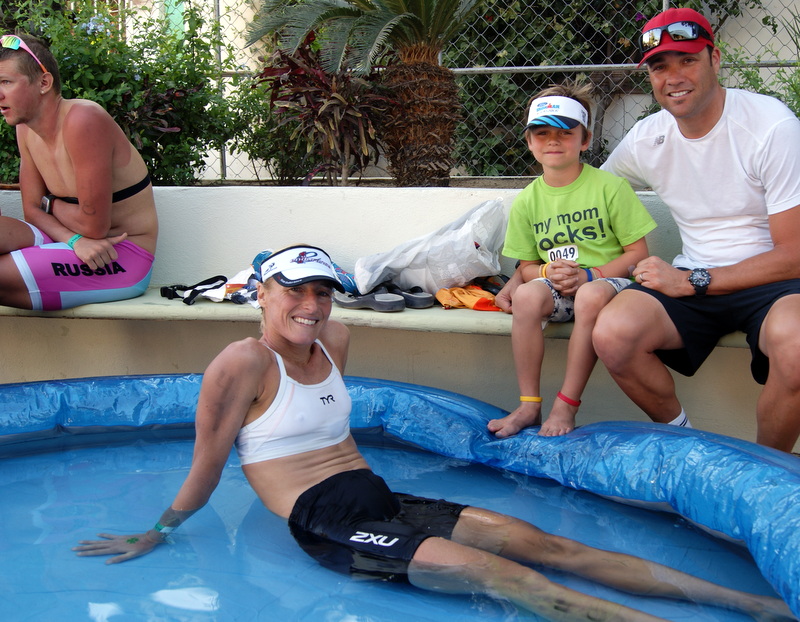
For about 10 hours Sunday, I floated about the finish line of the first Los Cabos Ironman Triathlon. If I heard it once, I heard it a hundred times - "Congratulations, Nancy - or Kathleen or Christine or Molly or Heidi - you are now an Ironman." Would it have killed the announcer - and I have to say, he sounded as enthusiastic, happy and proud for each competitor at midnight as he had at 3 p.m. - to say "Ironwoman"?

Calle Valerio Gonzalez Canseco never had less traffic
But maybe that would have raised gender issues that Ironman sponsors would rather not address. On the other hand, the Ironman organization is recognizing its 35th anniversary this year, so it has been around long enough to already have debated and settled the matter. I don't have a clue. Only a few of the participating women grumbled about the slight; most took it in stride. Before Sunday, I'd never even seen an Ironman Triathlon. I'd certainly never participated in one.

I was drawn to this one in large part because it was the first to be in San Jose del Cabo and because the organizers had put out a call for volunteers. I signed up and put in stints each of the key days, Thursday through Sunday. The first two days I worked the registration counter, where I was to greet incoming athletes, verify their papers and issue their credentials and assorted other things to confirm their participation. I got to meet people from all over the world - Australia, Germany, Costa Rica, Ireland, Panama, Wisconsin, Colorado, France. I met a woman from Argentina so happy to be taking on this challenge for the first time she couldn't stop beaming, and a septuagenarian from New Jersey who was about to participate in his 130th triathlon; he wasn't smiling as much - "This is costing my wife and I $4,000." Some 400 were from the United States, another 400 or so from Mexico, including a large contingent from Mexico City. I was issued my very own stapler, but what made me feel like a real Mexican bureaucrat was when I got to shake my head over their lack of documentation and direct them to the table where they were to fill out another form, to the copy machines where they were to print out copies of their passport or driver's license, and to the booth of the Federacion Mexicana de Triatlon where they were to fork over another 125 pesos (about $10 U.S.) for a slip of paper I had to staple to all the rest of their documents before I could strap on their wristband (to sign up, they'd already paid $650 each). They indulged my weak joke: "Congratulations, you've just finished the first of the three legs."

I looked forward to seeing many of them again, or at least to learning how they finished. As a group, they were fit - no surprise there - but also persistently positive, not at all intimidated by the course that awaited them, a 2.4-mile swim at dawn just off the beach at Palmilla on the southern edge of San Jose del Cabo, a 112-mile cycling race on a course that wound about San Jose del Cabo and Cabo San Lucas, and a three-lap, 26.2-mile marathon in San Jose del Cabo.

Winner Timo Bracht and his wife Bettina
I didn't, however, want to see any of them in the medical tent where I was assigned the day of the race, but I did; the positively giddy Argentine woman was brought in by ambulance after she faltered early in the cycling segment. I made the mistake of asking her what in the world she was doing on a cot, at which point she burst into tears. I never did see the guy participating in his 130th triathlon, but the list of participants after the race indicated he didn't proceed beyond the cycling leg. When I wasn't in the medical tent, I generally was at the finish line, casually and quickly sizing up the condition of the finishers and escorting most of them to the recovery area. On the long serpentine path to the cooling pools and massage tables virtually every participant said the Los Cabos course, which included a total vertical climb of between 5,500 feet and 6,000 feet, was the toughest they'd faced, even more challenging than the world-championship route in Hawaii. It didn't help that Sunday also was one of the warmer days of the year in Los Cabos, with the heat complicated by stiff and erratic winds.

Despite the camaraderie I saw in the registration lines and at informal gatherings leading up to Sunday, participation in a triathlon is basically a lonely undertaking, with each competitor having an individualistic goal - to improve their time, to qualify for the world championships this fall in Hawaii, to simply finish. No one said a word about the $75,000 in prize money. More than one said triathletes almost without exception are "Type A" individuals, which was enough to explain their gumption, sacrifice and dedication.

A few other observations:

- The bigger the guy, the more likely he was to break into tears when crossing the finish line.

- By and large, Mexican competitors finished the course in stronger shape that participants from the United States. Don't know what to make of that, but a disproportionate number of the Mexicans looked as fresh and strong at the end as they had at the start; very few ended up in the medical tent. Maybe they simply were more acclimated to the heat and the sun.

- A surprising number of finishers volunteered that the volunteers were doing a smashing job of providing support while they were in town, particularly during the race. A lot of those volunteers, incidentally, were youths, who virtually to a person were conscientious, energetic and focused, though at the end I was ready to throttle the girl who at every opportunity seemed to be grabbing my red "Medical" shirt and urging me to hurry up and attend someone who was throwing up in the recovery area; generally, all they needed was a little time to catch their breath, turn in their tracking chips and get their "Finisher" t-shirt before easing onto massage table, recovery mat or ice bath. Actually, I admired her spunk. No matter how dazed and exhausted a competitor, incidentally, they all had enough wits about them to grab that "Finisher" t-shirt and check that it was the right size before relaxing.

Kathleen Calkins cools off with husband Shane, son Brady
- As an old newspaperman, I continue to look for the local angle. I found it when one of the persons I helped register early on was Kathleen Calkins, from Gold River, a suburb of the California's capitol city, Sacramento, where I live when not in San Jose del Cabo. Turns out that while the principal newspaper in our home region hasn't done a feature on her she's one of the world's high-ranking triathletes, finishing fifth among the professional women with an overall time of 9:46:55, just 11 minutes and 21 seconds behind the winning woman, Erika Csomor from Hungary. The winning man was Timo Bracht from Germany with an overall time of 8:26:48. Calkins, who purely by chance I spotted during the cycling segment before starting my turn at the medical tent, was one of those competitors who looked as fresh and relaxed at the end as she had early on in the race.

The day after: cleanup time
- There were glitches in the running of the triathlon, to be sure, such as no clear and comfortable area for friends and family to reunite with participants, particularly those who ended up for an uncertain stretch in the medical tent. On the other hand, most of the long-standing potholes in the roads that constituted the course got patched, and even dreaded topes - speed bumps - got resculpted so they wouldn't jar or throw speeding cyclists. From the standpoint of a volunteer, the most serious shortcoming was poor scheduling, coordination and communication early on; few volunteers appeared to be given a date, time and assignment beforehand, and, like me, just showed up at Ironman central to be directed to a specific place and role. Though volunteers took this lack of foresight in stride, it is something that needs to be rectified before next year's Los Cabos Ironman Triathlon, which, incidentally, is to be March 30.


Tuesday, March 5, 2013

Catching Up With San Jose Del Cabo

I've been remiss, also spelled l-a-z-y. No posting has appeared here for nearly a year. But after more than a month back in Los Cabos, and with spring break just around the corner, the time seems right to share a few discoveries that have gotten me excited this visit. Here's hoping they interest visitors soon to arrive:


Lyle Brunson with a rubbing of a Sea of Cortez dorado
- You can find some mighty fine produce at the Saturday farmers market in San Jose del Cabo, but the influx of vendors selling prepared foods and assorted arts and crafts looks to be outpacing the proportion of real-live farmers dealing in raw provisions. You can rue it or you can enjoy it, and after my initial hesitation I've come to appreciate the greeting-card artist, the furniture makers and even some of the jewelers. The vendor with the most unusual and striking art to sell, however, just may be Lyle Brunson of Los Barriles, a fishing and second-home retreat just to the north of San Jose del Cabo. Brunson practices with precision and sensitivity the old Japanese art of gyotaku printing, whereby freshly caught fish are painted with ink (in his case, acrylic), covered with a cloth (in his case, unbleached muslin made in Mexico), and then hand-rubbed in the style of tombstone rubbings. A longtime yacht skipper in the Caribbean and then Hong Kong, Brunson was taught the technique by a Japanese friend's grandfather before he moved to Baja 12 years ago. In addition to these sorts of prints, he is apt to be found along the beaches of the East Cape between San Jose del Cabo and Los Barirriles, ready to do rubbings of trophy catches as they are hauled in.


Markus Saffert, and Maria
- I'll admit it, I'm not a big fan of Cabo San Lucas, the tourist-heavy port about 20 miles southwest of San Jose del Cabo. That's probably because it's where we have to go each spring to renew our immigrant status, a process so needlessly complicated and unpredictable that I suspect it was modeled on the system used in the U.S., thus explaining why so many Mexicans hoping for work north of the Rio Grande bypass the bureaucracy. Lately, however, I've come to recognize that Cabo San Lucas has several things to offer other than anxiety attacks. One is The Cabo Bakery, a relatively new enterprise whose profile was jacked-up unexpectedly last summer when the G-20 Summit, a gathering of finance ministers and presidents from throughout the world, convened at San Jose del Cabo's new convention center. Someone involved in the correct feeding of these dignataries apparently had stopped in at The Cabo Bakery, liked what they saw in its cinnamon rolls, apple empanadas and so forth, and commissioned it to provide the conference with its baked goods. Bakers in San Jose del Cabo reportedly weren't pleased with the choice, but ever since area residents and visitors alike have been thronging to The Cabo Bakery along Avenue Lazaro Cardenas just up from the beach. There, owner Markus Saffert and staff member Maria are just barely keeping up with demand for their baked goods.

David, at work at Monkey Business
- Pleasure in Cabo San Lucas also is to be found at the walk-up bar Monkey Business in the core of the tourist district, fittingly just up the street from the immigration office. There, bartender David painstakingly mixes margaritas both robust and refreshingly tangy, and palomas that respect the nature of the tequila he pulls from the shelf. He seems to taste every cocktail he makes to verify that it measures up to his high standards, but I've seen him at the end of his shift, walking away upright and straight.

Pizzas at Flora's Field Kitchen
- Not so much discovery as rediscovery, our two favorite dining destinations in San Jose del Cabo remain at the top of their game. Restaurant H in San Jose's art district has relocated, but not far, moving only next door into quarters once occupied by the pirate bar El Morro. This move gave chef/owner Luis Herrera about a half-dozen more tables where he continues to deliver his modern and personal interpretation of traditional Mexican cuisine. The restaurant that continues to generate the most buzz in Los Cabos - Flora's Field Kitchen - actually has improved since a year ago, mostly by more focused service and a more relaxed attitude, which had become haughty as personnel were carried away with all the acclaim its food and setting was receiving. The centerpiece is the farm's open-air restaurant, but it is much more than that, including a sprawling and varied produce garden that visitors once again can stroll about without being harassed by management, a cluster of culinary cottages, a farmers market, an art gallery, a bakery and a bar. Three fellow diners at brunch recently swore that the "Hair of the Dog" cocktail they ordered was the best-ever interpretation of a Bloody Mary, while I had no quibble about my earthy and spicy beet-and-ginger margarita. Reservations highly recommended, and given its location a few miles outside of San Jose del Cabo, consult the map on its website.

A statue in the San Jose cemetery 
- Other rediscoveries worth noting are two attractions so quiet and unassuming that most visitors hell-bent to get to downtown San Jose del Cabo's farmacias from their rooms along resort row stroll right by them. One is the settlement's old and historic cemetery, surrounded by a tall and rippling wall that explains why it is so easily overlooked. The gravesites are squeezed in tightly. Virtually each one is ablaze with artificial flowers in a dazzling range of style and color. Simple crosses mark some sites, while veritable chapels loom over others. The plot of an apparent avid fisherman is topped with a concrete replica of his boat. The plot of the local hero of the U.S./Mexico war, Antonio Mijares, is marked by a large but curiously plain monument. The cemetery is at once reverential and joyous, an oasis of eternal contemplation in the middle of a zone devoted to escape and pleasure.

Hopeful fisher casts his net in the estuary
Directly across Mijares Boulevard from the cemetery is the estuary, the reason why there is a San Jose del Cabo at all. Here is the one spot where early sailors on the Manila-to-Mazatlan run could depend on a supply of fresh water. It's also where the settlement's first mission was established, though mosquitoes compelled the early friars to move inland in hopes of escaping them. Today, the estuary is a wild, scenic and peaceful domain that endures despite the abuse locals have inflicted upon it. This is where they built the noxious sewage-treatment plant, and this is where vandals periodically set ablaze its groves of palm trees. No concentrated effort has been undertaken to develop a series of paths through the estuary, though over the past year some attempts have been made to clean up and bring some sort of respect and order to the place. It is home to countless varieties of migratory and resident birds, and a favorite destination of fishers. As I strolled about the estuary one recent day I came upon an apparent local who had ridden his bike into the enclave, secured a shady spot on a bank, turned on his portable radio, and to the music was belting out ballads so melodic and sincere I expect to see him on the Latin America equivalent of "American Idol" any day now.

Tuesday, March 27, 2012

A Look At Who Is Being Killed In Mexico

Just as spring break commences, with wary but excited residents of the United States descending upon the beaches of Mexico, the Trans-Border Institute at the University of San Diego has released its third annual report on drug violence in the country.

The bottom line: Mexico is more dangerous than ever, at least it was last year, but the carnage is slacking off.

You can read the entire 29-page report here, or you can just mull over these gleanings:

- Since President Felipe Calderon took office on Dec. 1, 2006, some 50,000 killings in Mexico have been linked to his war on organized drug-related crime. At the start of his administration, one drug-related homicide was recorded every four hours. Last year, one drug-related homicide occurred every 30 minutes.


- This past year alone, around 16,000 persons were killed in drug-related showdowns, up 1,650 from 2010. That's an 11 percent increase, but down sharply from a jump of nearly 60 percent the year before.

- About half of all homicides in Mexico last year were tied to drug violence. Two of every five killings occurred in just three states - Chihuahua, Sinaloa and Nuevo Leon.


- On average, some 40 people were killed daily in Mexico this past year, three of whom were tortured, one of whom was decapitated, two of whom were women, and 10 of whom were "young people" (undefined in this section of the report, though the document elsewhere suggests "young people" are between 15 and 29).

- Mexico's overall homicide rate is 18 per 100,000 inhabitants. As the report notes, however, that's not so bad when compared with other Latin American countries, like Honduras (82), Guatemala (41), Brazil (22) and Puerto Rico (26). The homicide rate in the U.S., incidentally, is about 5 per 100,000 residents.

- An estimated 2,000 persons were killed last year in each of just two cities, Ciudad Juarez and Monterrey, compared with 613 in Los Angeles, 441 in Chicago, 318 in Philadelphia, 209 in New York City, and 133 in Dallas.

- Nevertheless, of all the killings in Mexico the proportion in border towns fell from 29.5 percent in 2010 to 17 percent in 2011. The killings in Tijuana, for example, slipped from 349 in 2010 to 166 in 2011.

- Increasingly, women have been the victims of killings related to organized crime, up from 194 in 2008 to 904 in 2011.

- The drug wars are the leading cause of death for "young people," who in this section of the report are defined as persons between 15 and 29. Their death toll has jumped from 366 in 2007 to 3,741 in 2010. They generally are called "ni-nis," for "ni trabajan" and "ni estudian," meaning they neither work nor study.

- Last year, eight reporters were killed n Mexico, at least three of them for reporting on the drug trade. That's down from the 10 journalists killed in Mexico the year before.

The report is long on methodology and statistics, but doesn't shy from analysis and advocacy. The killings clearly stem from government efforts to curtail the drug trade and from conflict among cartels competing to produce and deliver narcotics, the authors conclude. Efforts to show that the rise in drug-related homicides reflect domestic insurgency or narcoterrorism, a view that looks to be gaining currency in the United States, "seriously misdiagnose the problem," say the authors.

Mexico's inept and corrupt criminal-justice system complicates the issue, indicates the report, which more than once calls for more transparency, efficiency and fairness in law enforcement. As a measure of the population's lack of confidence in police, more than 75 percent of all crimes go unreported, the authors say. And of those reported, only "one or two of every 100" results in a sentence.

Though the report urges politicians to consider more seriously alternatives to Mexico's current drug policy, it also notes that little evidence has been accumulated to support decriminalization or legalization of the kinds of drugs involved in the crackdown on trafficking. Nonetheless, the researchers criticize politicians for dragging their feet in discussing frankly liberalized options to current drug laws.

The Trans-Border Institute, based at the Joan B. Kroc School of Peace Studies at the University of San Diego, aims to promote understanding a cooperation between the United States and Mexico. The authors of the report are Cory Molzhan, Viridiana Rios and David A. Shirk.

Wednesday, March 14, 2012

Fresno Boy Basks In The Mexican Sun

At 8, Frank Arnold discovered his artistic talent.

At 8, he also learned that he was adopted.

Those twin realizations immediately inspired him. Emboldened by the first, stung by the second, he vowed that henceforth he'd be his own person, independent and self-reliant. "I made a deal with myself. I'd take no money from them," he says of his quiet rebellion with his parents.

He sold newspapers. He mowed lawns. He ran a gas station. To pay his way through college, he started a sign business, which he later parlayed into an advertising and marketing agency. On weekends, he painted and sculpted.

Frank Arnold, framed by ancient wood door from Guadalajara
Today, Frank Arnold is an established abstract expressionist whose paintings can command five figures. Summers, he lives and works in Fresno in central California's San Joaquin Valley, where he's president of Ashford Advertising. From fall until spring, he's in San Jose del Cabo at the southern reaches of the Baja peninsula. In the heart of San Jose del Cabo's thriving downtown art district he's built a blocky stone-and-concrete 8,000-square-foot compound that houses studio, gallery and residence. It's in the city's old red-light district, just a block from the mission church. He shares it with his wife of five years, Carmen Capshew Arnold, and their feisty bichon, Picasso, which he walks daily through the scraggly arroyo just to the north of the complex.

At 8, Arnold and his family were living at Bakersfield in the southern San Joaquin Valley. One event of the local fair was a flower-arranging contest. He entered it, and his arrangement won a blue ribbon. "I just liked color a lot. I couldn't believe how beautiful colors could be," he recalls.

At around that time he learned rather off-handedly that he'd been adopted. "I was reading a newspaper, and an article had the word 'adoption.' I asked my mother, 'What's adoption mean?' She said that that's what happens when someone can't take care of you. I asked her if I knew anyone who'd been adopted. She said, 'You are.' I thought the way she told me was really rude," Arnold says. "My (adoptive) mother often was sick. She didn't care for me. My father was a truck driver who wasn't home a lot. We were semi-poor, so I was kind of on my own already when I made that deal with myself to be self-sufficient."

Since then, the number "8" has stood for his signature on many of his pieces. "That's me," he says of the number. "It's a loving number for me."

He's never met his biological father, who was in the U.S. Coast Guard when he was conceived. He met his biological mother when he was in his 30s, and they're grown close.

Frank Arnold with his painting "The Wiz"
Today, Arnold is a thick and cheery guy. His hair stands upright in a spray of waves that mimic the surf of the nearby Sea of Cortez. His soul patch is the tip of a small paint brush dipped in platinum. He favors glasses tinted blue, unless he's in the mood for the pair whose lenses are gold. He's down to earth, practical and relaxed. His gallery is a popular spot on San Jose del Cabo's Art Walk, each Thursday evening from fall into spring, and not just for the tequilas he pours.

The walls of the gallery are hung with his large canvases, most of which feature a tall, lean and solitary figure, their faces sketchy. They can be ghostly, yet also taut, conveying tension and power. His colors can range from muted to luminous, and at times the oils are applied so thickly that ridges emerge in relief from the flat panels. His paintings have been likened to the figurative works of the late Stanford University abstract expressionist Nathan Oliveira, and in Arnold's takes on guitars and dogs can be sensed the hand of Pablo Picasso, but he says he hasn't drawn inspiration from anyone but himself. "I never paid attention to anyone. I did my own thing," Arnold says.

As abstract as they are, virtually each painting is autobiographical. He refers to them as an entry in a diary, a chapter from his past or present. "They're stories about my life. I daydream while I paint, and go with that. They can be whimsical, painful, ironic," Arnold says. Family members will figure in this or that painting, sometimes via secret codes he etches here and there. He figures he's gone through four periods so far. One dwelled on mother and child. Another sprung from past incidents in his life. Nowadays he's focused on current events. "They're my stories," he says of his paintings, "but other people often bring their own stories to the paintings. The paintings trigger something in their own lives. Women especially break down and start to cry. They've lost something or someone, a love or a spouse."

Frank Arnold's "Cabo Bird"
But Arnold also occasionally indulges an impulse to be playful, allowing his colors to be bolder and brighter, his strokes broader, his figures more accessible. The dog and bird of "Spotty" could be straight out of a children's book, "Chair Fish" is more amusing than unsettling, and "Cabo Bird" - purchased by members of Seattle's Nordstrom family - looks as friendly as something that just flew in from San Jose del Cabo's nearby estuary. "I'm not often in a silly mood," says Arnold when asked why he doesn't show his lighter side more often. "I'm happy, but I don't feel very whimsical very often. And it's hard to pull off the whimsical as serious art."

The more carefree paintings tend to spring from his time in San Jose del Cabo. Paintings completed in Fresno are more structured, he says. "Life in America is more structured, more regimented, tighter," Arnold says. "You can mark every day in America by something stressful that happens to you. Here, the days float away, life disappears faster here; there are no stress points."

Born in Long Beach, Arnold spent his formative years in Visalia and Bakersfield before his family settled in Fresno. He graduated from McLane High School in Fresno in 1969. Five years later he earned an associate of arts degree in art at Fresno City College. He continued to study art at Fresno State College, but dropped out to teach art at night school in nearby Clovis. When he discovered that he both didn't like teaching and wasn't particularly good at it, he went into marketing. On weekends, away from his ad agency, he sculpted and painted "for fun." Before long, his artwork had made him "semi-successful."

Decanters of tequila await guests at Frank Arnold's gallery
About a decade ago, Arnold began to scout Mexico for a spot where he could build a combination gallery, studio and home, the kind of complex for which he doubted he could get a permit in the United States. Also, it had to be someplace where he could work outdoors whenever he wanted, in part to avoid the intake of paint fumes. The prosperous art communities of Mexico City and Puerto Vallarta were tantalizing, but more intimate San Jose del Cabo also was attracting an influx of artists. On top of that, San Jose del Cabo, with its international airport, was easy for him to get to, and the region's growing number of posh retreats, resort hotels and gated communities looked as if it would draw the sort of clientele that could appreciate and afford his paintings and sculptures. He finished the compound four years ago, and as he'd hoped his work now hangs and stands in homes throughout the United States and Canada. He figures that most of his sales in San Jose del Cabo are to collectors visiting from New York City, Chicago, Vancouver, Toronto, Aspen and San Francisco.

He will stay in San Jose del Cabo a little longer than usual this spring, primarily to see what develops when the G20 summit convenes in the town's new conference center in June. The gathering is to draw hundreds of finance ministers, presidents, diplomats and other dignitaries from the world's most prosperous economies. He doesn't know or even care whether he will sell any art during the conclave, but he has a hunch that he will get at least some beneficial exposure.

Aside from that, the compound he's built and the lifestyle he's created have worked out just as he envisioned when he thought of them more as fantasy than realistic goal. "I wanted a studio where I could work and a gallery where I could sell. I wanted a pretty simple life, and I think it has happened. I didn't expect to be a Fresno boy selling paintings to people from New York and Chicago in San Jose del Cabo. I've been blessed."

Frank Arnold's gallery, San Jose del Cabo

Tuesday, February 7, 2012

A Papal Prayer Could Help

As his term winds down, Mexican President Felipe Calderon is banking on a glorious spring to assure that memories of his administration aren't limited to a brutal drug war. In March, for one, Pope Benedict XVI is to visit the Mexican state of Guanajuato, where rival drug gangs already are trying to outdo each other in calling for a truce during the papal tour.

Then, in June, President Calderon is to chair the next gathering of the G20, the finance ministers and often the presidents of the world's more powerful economies, including the European Union, the United States, South Africa, South Korea, India, Brazil, Russia, Japan and France. The intent of the annual meeting is to discuss and resolve issues jeopardizing the stability of the global economy.


Los Cabos Convention Center, three weeks ago...
In five steps from the laptop on which I'm typing I can stand on the second-floor landing of our residence in San Jose del Cabo. When I look west I see the bright red top of a massive crane poking above a hill dense with prickly cactus that hasn't yet been cleared for fairways and homes. When I stroll up there, I can look down at a sprawling and dusty site where construction crews appear to be working 24/7. This is the future home of the Los Cabos Convention Center, where the finance ministers and heads of state of the G20 are to meet in four months.

The website that either Mexico or the G20 created to help showcase the gathering claims that "Los Cabos has all of the necessary facilities...to hold this important international event." That's a stretch, given the frantic efforts to create virtually overnight the region's first substantial and secure convention center. Work on the project began just this fall. Will it be ready for the summit? Local residents are speculating about that, with most seeming confident that it will be. (However, today's Los Angeles Times feature, about Mexico City's controversial bicentennial monument, the Pillar of Light, which was unveiled 16 months late, isn't encouraging.) Even if the convention center isn't ready for the summit, locals are excited about what it will mean for the area when it is finished: A place big enough and plush enough to draw even more foreign visitors to the region's golf courses, resorts, pangas and beaches.


...and yesterday
Why hold the G20 summit here at all, when Mexico City, among other cities, already has the infrastructure to support such a meeting? Proximity to Los Cabos International Airport no doubt played into the decision. But more significantly, some observers speculate, the Calderon administration wants the conclave in one of the country's more remote and isolated states for two reasons: For one, Baja California Sur generally has been free of bloodshed stemming from the administration's pursuit of drug cartels; secondly, protestors who habitually show up at G20 conclaves aren't as likely to go this far out of their way to demonstrate.

A local English-language newspaper, the biweekly Gringo Gazette, puts the cost of the nearly 60,000-square-foot facility at $91 million in U.S. currency. As I look at the scale of the construction, however, that seems low. At the least, I doubt that that figure includes the cost to build an access bridge over the highway that dignitaries will use en route from and to the airport. That's nearly complete.

Friday, January 20, 2012

Surprise: Small Businesses Surviving Walmart

When I last posted here, a Walmart Supermercado just had opened in our neighborhood of San Jose del Cabo. I fretted about the impact that the massive emporium would have on the small grocery stores, panaderias, tortillerias, viveros and other independently owned businesses in the vicinity. That was in April. Then we returned to California and pretty much forgot about San Jose del Cabo.

Now we're back in Los Cabos. I haven't yet strolled about our entire neighborhood in San Jose del Cabo, but I have walked down and about Calle Valerio Gonzalez Canseco, the long street topped by the new Walmart. This much seems clear: Walmart has had little negative impact on businesses along the strip. Quite the contrary. I can't recall ever seeing so much industry along the street. Sure, much of it is traffic drawn by Walmart. And granted, at least one small grocery store is gone, and one cafe looks like it just closed for good. On the other hand, one grocery store is new. A couple of cafes have been added to the street. I saw three boutiques I don't recall from before, two dealing in fashions, one in furniture. A new nursery has opened just off the street. A small panaderia looks to still be flourishing, despite Walmart's close and expansive in-house bakery.

And Papeleria Maya still is open. This long has been our favored outlet for basic office supplies. I suspected it might be one of the early businesses to fold once Walmart unveiled its sprawling departments catering to school and office needs. Why is Papeleria Maya still around? Its proximity to three schools helps, but, again, Walmart isn't far removed from those schools, either. Here could be another reason: When we arrived back in San Jose del Cabo, one of our first needs was for an ink cartridge for the printer. Ordinarily, that would have meant a trip to Papeleria Maya. I had to go to the south edge of town on another matter, however, so I stopped in at OfficeMax to pick up a cartridge. It cost me 269 pesos, about $21 at the current exchange rate. Later, I discovered that Walmart charges the same price. Earlier today, I stopped in at Papeleria Maya to find out about the price of the cartridge; it's 196 pesos, or around $15. I should have stocked up; given the buying and marketing power of Walmart and OfficeMax, who knows how long Papereria Maya can hang in there.

Friday, April 8, 2011

Walmart: Fine Wine, If You Can Get To It

Road-building crews are laboring day and night at the intersection of Calle Valerio Gonzalez Canseco and Boulevard Mauricio Castro, also known as the Transpeninsular Highway, in the heart of San Jose del Cabo. Not sure what they are up to, but the project looks to be an afterthought prompted by the opening this past week of a sprawling Walmart Supermercardo at the intersection. At this late hour, crews won't be able to do much to relieve a bottleneck that any urban planner should have seen coming by just looking at the paperwork and taken a drive.

In a way, it's gratifying to see a corporation like Walmart tackle this sort of in-fill project right in the middle of town rather than building on the outskirts, thereby again contributing to urban sprawl. The lot that the massive structure now occupies previously was an eyesore, which to judge by the stentch that arose from it had been used in large part as a dump for abandoned pets. Any business on the site would have been an improvement, but the scale of the Walmart is laughable, which it is as long as you don't have to put up with the congestion, either as motorist or pedestrian.

Given the size and popularity of Walmart, why couldn't city authorities see this coming, or did they and just not care? Even without Walmart on that corner, traffic congestion had been intensifying. Calle Valerio Gonzalez Canseco long has been one busy street, thus the six topes that try to slow drivers heading up or down the slope. As construction of the Walmart progressed several new businesses joined the numerous schools, restaurants and cafes already lining the street, providing a glimpse of what was coming. San Jose del Cabo residents are grumbling about the placement of the Walmart and the additional traffic it is drawing, but it's pretty late in the game for any kind of effective opposition to develop.

By the time we return to San Jose del Cabo next fall or winter I suspect that Walmart will have wiped out several of the grocery stores, tortillerias, panaderias, viveros and other small businesses that exist in virtually every neighborhood of the town. On the other hand, a large Office Max on the south edge of town so far hasn't seemed to put out of business any of the papelerias alongside virtually every school in the community, so Walmart's impact might not be as severe as anticipated.

As I strolled about the new Walmart I was struck by the caliber and depth of its wine department. I can't recall a Walmart in the United States stocked so extensively, especially with such prized and pricey releases as the House of Morande 2004 Maipo Valley Bordeaux Blend (about $65 in U.S. currency), the De Martino 2004 Maipo Valley Cabernet Sauvignon ($43), the Adobe Guadalupe 2006 Miguel ($33) and the Baron de Chivel 2001 Reserva Rioja ($137). Clearly, Walmart is taking on the town's few fine-wine shops, which will be another endangered species in the area. Good luck; we'll be hoping they all are surviving when we return to San Jose del Cabo.

Thursday, March 31, 2011

For Our Next Stay, Please Beef Up Your Coverage

An open letter to Fernando Gonzalez Corona (publisher) and Ruben Valdes (editor) of the Los Cabos Daily News:

Since returning to San Jose del Cabo three months ago, we've subscribed to the Daily News, looking forward each morning to its mix of international, financial, lifestyle and sports news, as well as the crossword puzzle.

We're now starting to pack up for our return to Northern California. When we come back to San Jose this fall or winter, I'd like to see some changes in the paper if we are to resume our subscription:

Mostly, I'd like to see more local news. This shouldn't be too difficult. I believe you also publish Spanish-language newspapers with a heavy focus on Baja California Sur generally and Los Cabos specifically. How difficult would it be to translate and include in the Daily News some of those articles? Not difficult at all, I suspect. I believe your ex-pat audience would be more interested in compelling local stories than articles on international events about which they already have been well briefed by CNN and other sources of televised news. By continuing to focus on news out of Washington, D.C., and New York City you are missing an opportunity to close a gap within Los Cabos, and that is the division between the local fulltime native population and the community of residents from elsewhere who live here perhaps only part of the year, but who nonetheless want to be active and positive members of the region. Every time there's a fire or some other incident at the estuary, for example, my wife and I want to know about it, but we never find any sort of report in the Daily News.

If nothing else, add a comprehensive and accurate calendar of local events. Residents who live in Los Cabos just part time but who would like to be a part of the local culture while they are here have no consistent and reliable source that I am aware of to become aware of and to participate in the terrific range of cultural events that occur in and about Los Cabos. Where can I find a schedule of soccer matches at that outstanding stadium in Cabo San Lucas? How do I learn of races at the magnificent velodrome in San Jose del Cabo? That's a goal you should recognize and capitalize on.

OK, I recognize that this sort of additional local coverage can be costly - more expensive than ripping and pasting feeds from The Washington Post and Bloomberg News - but you are missing a potentially lucrative revenue stream by ignoring restaurant news and restaurant advertising. By my experience, when family and friends come to Los Cabos they first want to know about the local culinary scene - where to eat, where to find values, who is doing the most exciting cooking, what's the story behind that cafe or that food stall at the municipal market? You don't have to publish restaurant reviews, just a column of news items about what's new, what you've discovered, and what's inspired this chef or that restaurateur. I'm a longtime journalist, now largely retired, who spent many years reviewing restaurants. I'm not looking for work, just passing on what I consider a valid observation from my experience, and that is that people love to eat out, especially when they are on holiday, and welcome informed and fair guidance.

Finally, I'd like to see more news in the Daily News from the western U.S. I sense that if you were to canvass your readership you would find that it consists mostly of people from California, the Pacific Northwest and Canada. Your current news sources only occasionally cover the issues and personalities of those regions, however. While I admire The Washington Post and the breadth and depth of its coverage, I think you would better serve your readership if you also subscribed to such syndicates as the Los Angeles Times and McClatchy News Service, the latter of which I have had a longterm relationship, though in a modest role.

Please take my suggestions in the spirit in which they are intended: I enjoy the feel of newsprint in my hands each morning, and just want the contents of the paper I'm holding, in this instance the Daily News, to be more compelling, more successful and more influential among local residents, whether they live here fulltime or part-time.

Tuesday, March 1, 2011

Halfway There, We Hope

I've got it, a solution to the immigration issues poisoning what could be a mutually beneficial relationship between the United States and Mexico. I saw the light almost by accident, and, ironically, in Mexico itself. In short, all United States authorities need to do to resolve today's acrimonious debates over immigration is to adopt the same sort of measures that Mexico imposes on immigrants who want to work in the country, stay longer than six months, take advantage of medical services and own property: Compel them to get an FM2 or FM3 visa.

I'm not sure what FM2 and FM3 means, though wags in Mexico glibly refer to them as Foreign Moron Second Class and Foreign Moron Third Class. Whatever, one or the other is supposed to facilitate ordinary life in Mexico for expats, from getting through the airport to transferring property. We were told this a few years ago by various people who long have lived in Mexico. At that time we were starting to entertain thoughts of residing part-time in Baja California Sur. We bought their advice, and soon after we bought our casa we applied for our FM3 visas. Since getting them, I haven't realized any advantages, but I also haven't tried to find a job.

Instead, our FM3s have become a source of frustration, confusion and anger, but only on the day when we begin the annual renewal process, precisely one month before they are to expire. You have to do this in person in Mexico. The ritual starts with a trek to immigration headquarters in Cabo San Lucas. There, you first stand in line outside, then you and a dozen or so others dash upstairs to queue up again. (You should see the wheelchair ramp in this place. I've never seen anyone in a wheelchair actually attempt to go up or down it, but skateboarders practically droll at the steep, narrow and frightening challenge it offers; I tried to take a photo but the security officer stationed at the foot of the ramp grabbed me as if I were from Sinaloa, packing heat. He pointed to a sign indicating that no cellphones or cameras are to be used in the building. Meanwhile, at the top of the ramp, many of the people waiting to process their papers are on their cellphones.)

But back to renewing our FM3s. Here's what this year's exercise entailed, starting this past Thursday:

- A two-hour wait in the immigration office. There's a TV overhead, but it wasn't on. Every sign in the place is in Spanish. All the clerks speak almost solely Spanish, with little English. That's OK, it's Mexico, where Spanish is the dominant language, and anyone who lives there even part time probably should know enough to get by. Still, it is an immigration office, with most of the clients English speaking.

- After two hours, we're called up. We've been through this before. We know what to expect. We're ready. We've come with everything we've been directed to bring in the past: Copies of our three most recent bank statements to verify that we're more or less solvent and won't become a burden on the state's welfare services; our passports; our FM3s; copies of our most recent electricity bill to confirm that we're property owners. All this paperwork is enclosed in the required vanilla folders. (The people with blue folders are attorneys or agents who expats can hire for a fee of generally around $150 per FM3. They get to line up separately, though I'm not sure the service they get is any faster. A lot of them are Mexican women in tight pants and amazingly high platform shoes with spiked heels. The speed with which they can dash across the room in those shoes when their name is called is about the only entertainment you'll get if you didn't bring a good book.)

- The clerk flips through our paperwork quickly. He sighs, then tells us we don't have the new forms that have been required since late January. One of them has to be completed online. He points to a desk with a computer in the corner. He says if we have any questions about operating the computer ask the person in the information kiosk next to the desk. Neither then nor any time subsequently did we ever see anyone manning the information kiosk. We log on and find that all the questions are in tortured bureaucratic Spanish. A woman in line waiting to use the computer offers to help us maneuver through this minefield so she can get on with her own business. That task finished, we turn to the second form, to be answered by hand. The questions are surprisingly personal and dubiously relevant, but we proceed to fill in the blanks that ask about our race, education, complexion, height, weight, tattoos or scars, children, occupation, monthly income and religion (if I put down "Catholic" might that expedite the process, I wonder).

- Back to the counter, where the clerk notes that our names on the printout from the computer don't precisely match our names on our passports. We point out that the computer form asks for our names as they appear on our passports or on some other official identification. Because we are renewing our FM3s, we figure that our names on the form should be as they appear on the FM3s. We've figured wrong. The clerk insists that our names should be exactly on the form as they are on our passports. He directs us back to the computer to redo and reprint the forms.

- Back to the counter. He asks where our photos are. In the FM3s, we indicate. Nope, we need new ones, in color. By this time it's 1 p.m. We've been in the office four hours. The office is open weekdays only from 9 a.m. to 1 p.m. (I thought the same thing: Who handles their collective bargaining?) By this time we're thoroughly beaten down. We leave, find a small nearby photo shop whose only business is taking photos for visas. It's fast and relatively cheap - 120 pesos each, about $10. Next, we find a bank where we can pay our annual renewal fee, precisely 1,294 pesos each (about $110), and it must be paid in pesos only, no credit cards, no checks, no Unites States currency.

- We return to the immigration office first thing next morning, again joining the lines. The night before I've reviewed every possible contingency, and made backup copies of even backup copies. Nonetheless, I'm not confident that every base has been covered. The contradictions and delays of the day before were rattling, and I remind myself to adopt the attitude of the woman who'd stepped up to help us. She said she continually tells herself well before she gets to the office that "this is immigration day." She doesn't plan to get anything else done this day; she exercises her upmost patience; and she tries to keep smiling. I kept repeating that mantra, especially when the clerk asks the whereabouts of the two additional copies we were to have of our payment at the bank the day before. Yikes, I hadn't known we were to do that. But just as we were about to head out of the office in search of a copy shop, we ask if he might just make the required copies on the copy machine behind him. I feel uneasy about this, figuring we've already gone through a ream of paper and a printer cartridge, but he agrees, so I get over it.

- With that, he flips through the papers in one folder, then the other, shuffling, stacking, stamping and stappling. He then gives us a "very important paper," basically our receipt, which we are to bring to the office to pick up our new FM3 visas, anticipated in about a month. He points to a website address on the form and says we could go there anytime to check on the progress of our application. I've tried, following the directions over and over, but get a message that the page doesn't exist. We'll wait a week or two, then start calling the immigration office to find if our new FM3s are in.

I know what you're thinking: If only the immigration process in the U.S. were this onerous all those immigrants would beat a hasty retreat home. I'm not suggesting that at all. I've no idea what immigrants in the U.S. face if they hope to stay in the country for an extended time and perhaps find a job, go to school and buy property. The system in the States could be so daunting that it alone explains why some immigrants ignore it, but I doubt that. At the least, every direction will be in Spanish as well as English.

The Mexican bureaucracy is legendary for its finicky and rigid ways. The unprecedented computer station at the immigration office on our most recent visits, however, is an encouraging sign. Maybe the process gradually will become more logical and less irksome. (Oddly, not once on any of the forms we filled out were we asked an email address so immigration officials could keep us abreast of changes in their standards, which seem to happen annually.) Despite the computer, however, we went through more paperwork than usual, and clerks looked to be using no fewer rubber stamps, paper clips and glue sticks than ever. The clerks, incidentally, were never obtuse or mean-spirited, just equally unprepared in the details of the new procedures.

For sure, the Mexican system is inefficient, awkward and costly, yet we feel compelled to abide by it so we can be seen and treated as good neighbors. I wouldn't want to wish it on anyone, but I've a hunch the comparable means to allow immigrants to buy property, pay taxes and the like in the U.S. is more streamlined. Nonetheless, it apparently isn't perceived as being as necessary to live by as the visa procedure in Mexico, or it wouldn't be shrugged off as casually as it is. What I'd like to see is some sort of reciprocity between the two nations, so that immigrants from one country to the other can know beforehand what's expected of them and can comply with minimum hassle.

Given the traditions, history and proximity of Mexico and the United States, you'd think there could be more understanding and cooperation between the two countries. But relations appear to be nearly as strained as ever, with that grim fence snaking along the border a depressing symbol of political and diplomatic ineptitude in both countries. With leadership and imagination, politicians and diplomats should be able to come up with a relatively easy and encouraging way for citizens of both countries to cross the border and pursue their dreams in a manner beneficial to all concerned. That day seems far off, given the acrimony and fear generated  by overheated differences concerning guns, drugs and illegal immigration. Nevertheless, we can hope.

Thursday, February 17, 2011

Flat Tire At The Velodrome

When not in San Jose del Cabo, I'm generally in Sacramento, in northern California, variously also known as Alta California, Upper California and Superior California, all of which suggest some sort of inferiority complex. What I'm about to report won't help that, but it also could provide inspiration for Sacramentans to keep the momentum going.

I recently read on The Sacramento Bee's website a feature about the hopes of some city residents to build a velodrome, an oval track with steeply pitched walls on which cyclists can go as fast as they want and are able. In a sense, it's surprising that Sacramento doesn't already have a velodrome, given how many avid cyclists live in and about the city. Then again, there's always the American River Parkway, basically a bikepath that challenges cyclists for its more than 20 miles. But for racing, nothing apparently beats a velodrome, and consequently almost all of the more than 80 comments attached to The Bee feature endorsed the notion of building a velodrome in Sacramento.

The story reminded me that San Jose del Cabo has a stunning velodrome, which I hadn't yet visited during my current stay in the settlement, in large part because while I enjoy some cycling I'm not particularly interested in the sport as either viewer or participant. I saw Lance Armstrong pedal through Sacramento not long ago and found that about as exciting as watching the Daytona 500. Nevertheless, I made my way today up to San Jose's handsome velodrome, perched high on a hillside on the northwestern outskirts of the community. The velodrome is next to a large soccer complex, and flanked by basketball courts, all of which offer striking views of the Sea of Cortez. A cool breeze was blowing across the setting as the sun began to dip behind the mountains to the west. The whole complex represents a substantial monetary investment, even though getting there requires passing a barrio of lean-tos.

I've no idea whether that proximity explains the sorry state of the velodrome, but to judge by the littered grounds and the extent of the graffiti inside and out of the velodrome someone looks to be mightily irked by its presence. The track remains in fine shape, though a guy on hand to help coach the young cycling team in its practice session was reduced to spending a chunk of his time sweeping debris from the track. The velodrome is only around 18 months old, but municipal officials, he indicated, have dropped the ball in maintaining the facility and in providing adequate security. Come back early next month, he said encouragingly, for what promises to be a spirited meet involving several cycling teams.

What's the lesson here for Sacramento? Build a velodrome, but just make sure the money and interest are there to maintain the facility. Actually, from what I've also been reading, the city's NBA franchise, the Kings, may not long be in the community, leaving vacant a basketball pavilion that just maybe could be retrofitted into a velodrome. And with air conditioning, someting the velodrome at San Jose del Cabo doesn't have, though it does have all that sunshine and those caressing marine breezes.

Tuesday, February 15, 2011

No Menu, Just Delightful Dining

The Wall Street Journal has discovered restaurants without menus. This may be news in New York, but not in San Jose del Cabo, where for five years this month Casiano Reyes has eschewed menus at his intimate Restaurante Casianos.

We returned to the restaurant last night for our Valentine's Day dinner. The restaurant is in a depressed office and commercial complex on the southwest side of town, just above a urine-scented access to the beach. But once through the restaurant's curtained entry you're in a different world, where polished sophistication holds forth. The classy design runs vaguely to French and Spanish traditionalism. Black-clad servers were attentive and smart. For some reason, whenever we visit Casianos I expect to see George Clooney, a not-infrequent visitor to Los Cabos, according to the local press. Last night, however, no George, but there was some guy with the heft and confidence of a professional football player, though I couldn't place him without his jersey.

At any rate, diners are greeted with a parmesan breadstick that would please Biba Caggiano, a tray with a selection of fresh lemon, lime or mint to go in your glasses of water, and a question about whether you have any dietary restrictions. No menu is handed over, just an opportunity to specify whether you want the three-course meal or the five course.

Once that's resolved, a basket with four kinds of warm breads arrive, followed soon after by plate after plate of what Reyes calls "spontaneous cuisine." His intent is to surprise guests and leave them delighted by both their adventurous spirit and his precise cookery, perhaps best classified as New-Wave Mexican. Traditional staples of the Baja diet make their appearance, but in totally original presentations. Sweet scallops were sweetened even more with a concentrated puree of sun-dried tomatoes. The brightness and juiciness of finely diced watermelon contrasted with the crackle of its accompanying fried goat-cheese ravioli. A creamy corn sauce and a puree of beets lit up the lobster medallion with their earthy sweetness. A filet of sea bass covered with lentil scales floated on a sea of pureed green beans.

Filet mignon and New York steak aren't my favorite cuts of beef, but both were handled with imagination and care, the former exceptionally tender and rich, the latter succulent and smoky, its red-wine-and-rosemary sauce the perfect accompaniment.

The most unusual dish was a cylinder of poached potato filled with foie gras and blueberry. The foie gras, said our server, was produced at Guadalajara.

Dessert consisted of two kinds of cake (white chocolate for one, red velvet for the other) accompanied by two kinds of ice cream (rose petal for one, tequila for the other), both paired with pears that had been marinated in orange and thyme, then topped with feta.

Restaurante Casianos isn't inexpensive - 900 pesos per person for the five-course selection (about $75 at the current exchange rate) - but then Valentine's Day comes around just once a year. We stuck to wines by the glass, including a minerally and lemony Chilean chardonnay and a quiet Chilean pinot noir, after finding the restaurant's wine list to be the weak link in the operation. In excitement, the wine selection isn't up to the same level as the food, with most of the choices pedestrian and overpriced. The Bogle chardonnay is a fine take on the varietal, but not at the 700 pesos (nearly $60) that the restaurant expects to get for it. Nevertheless, Restaurante Casianos at five years old is continuing to meet its exacting standards.

Monday, February 14, 2011

OMG (Oh My, Gallo)

To judge by Saturday night's "Ritmos, Colores y Sabores" on the plaza in San Jose del Cabo, food festivals in Mexico don't differ much from food festivals in the United States. The serving starts a little late and progresses slowly, the lines get long fast, and the food disappears quickly; chefs were breaking down their stalls a little after 8 p.m., though the event was billed as lasting until 10 p.m. And in a sense, it almost did, given the range of entertainment that occupied the stage until nearly 10 p.m., long after most of the food was gone.

In that sense, Ritmos, Colores y Sabores - Rhythms, Colors and Flavors - was a step up from the entertainment at food festivals in the U.S., usually limited to some jazz combo nobody can hear because it's stuck in an obscure corner. Here, the entertainment went on and on, and at times was so lively it helped alleviate pressure on the food stands by distracting diners. The show included the large and uniformed glee club of a local elementary school, numerous high-energy vocalists, mariachi, folk dancers, fire dancers and belly dancers.

As in the U.S., participating restaurateurs donated dishes representing their menus in hopes of attracting new customers. It worked for me. I've added to my list of restaurants to visit before heading home Baja Blue Bar & Grill in San Jose del Cabo on the strength of its zesty seafood shots, La Galeria at the marina in Cabo San Lucas for its hearty nopales salad and fresh scallop-and-mango ceviche, Los Deseos Restaurant Bar at the marina in Cabo for its intriguing assortment of salsas, and Mi Cocina in the boutique hotel Casa Natalia in San Jose because of its bracing salad of scallops, octopus and nopales. By and large, the food was intricate and artful, the servings generous.

Sponsored by the Public Relations Association of Los Cabos to benefit a program assisting local women with cancer, the festival was well worth the price of 200 pesos per adult ($20 in U.S. currency). I think if they were to raise the price to $30 per person next year they'd still see the same size crowd, but hopefully they'd also arrange for more food. Aside from small sample shots of tequila and cups of coffee, beverages were an additional charge - 20 pesos per can of beer, 50 pesos per plastic glass of wine. And the only wines being poured, much to our dismay and no doubt much to the mortification of the Mexican wine trade, were by Barefoot Cellars, a California brand owned by E&J Gallo Winery. I've had pleasant Barefoot wines over the years, but the releases being poured Saturday night apparently don't travel well. Neither the cabernet sauvignon nor the pinot noir showed any varietal character, and overall weren't up to the quality of the food being served. That Modelo Light, however, isn't a bad can of beer.